
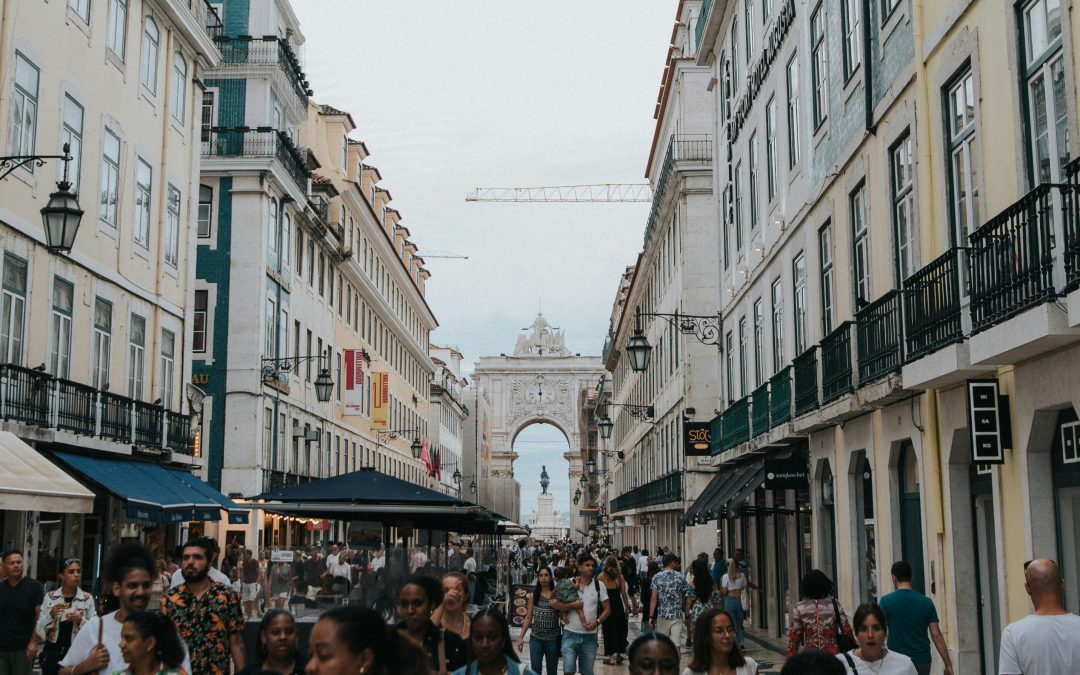
I’m just leaving Lisbon, where I’m part of a thoughtful initiative to address the widespread issue of gentrification, with cities growing ever more generic and inaccessible to locals. Tourism is a leading cause, but in Lisbon’s case, government policies designed to entice “digital nomads” have intensified the challenge. At the same time, both the size and the character of the city make it feel possible to find creative ways through, in what might offer inspiration to other parts of the world.
Our initiative is called Sensing Lisbon. Its goal is not to “solve” gentrification head-on. With something so complex, “solving” is not a viable approach. Instead, with support from afar and occasional visits (like this one) from me, the small local team of core stewards is working to cultivate an ongoing “learning ecology” of international residents and Lisboners.
Our intention is to sense the soul of Lisbon together over time, learning about ourselves along the way, and growing collective capacity to be with that complexity in generative, regenerative and reciprocal ways.
“The core inquiry of Sensing Lisbon,” we shared recently, “is to participate in a new kind of conversation with the city, one where we as residents and co-stewards make our presence matter to Lisbon’s vitality and wellbeing, and through that make Lisbon matter to the world in a new way.”
After an inspired launch event several months ago, we gathered again this weekend. This time, the invitation was to reflect together on two provocative questions:
Who can I be when I am with Lisbon?
And who can Lisbon be when she is with me?
The invitation asked people to embrace the ambiguity of these questions, suggesting that this is part of the practice we’re growing together.
The questions themselves are a twist on something Nora Bateson likes to ask: “who can I be when I am with you?” Her work seeks to grow the complexity – what she calls the “transcontextuality” – that a relational field is able to hold. If we only know each other professionally, for example, then I can only be the part of myself that is professional. The more contexts and complexity we are able to weave in, the more that “who I can be with you” grows to include the many parts and possibilities of “me.”
In applying this premise to our relationship with Lisbon, what emerged went beyond what we hoped and imagined.
After arriving in shared context and warm connection, we divided into small groups to take on the first of the two questions. And in my group, we found that we first needed to explore “who” Lisbon is. Feminine. Mature. Naughty, but also nice. Poetic. Slow and sensitive; never busy and buzzy. Safe. A village feel, with the amenities of a city.“People think we’re Southern European, Mediterranean,” shared one Lisboner. “But we’re people of the Atlantic. It’s rougher, more dangerous. We’re still accessible, but in a different way.” We noted that, over its long history, Lisbon has received wave after wave after wave of international residents. It has been a place of diversity and intermingling for centuries. This seems to be core to its DNA. In our parents’ and grandparents’ lifetimes, decades of dictatorship isolated the city from the rest of the world, as well as from modernization. But this has also left intact a certain groundedness and connection to the land. “Children here still know where their food comes from because someone they know still gardens.” We suspected this is why the regenerative movement has found such fertile ground here.
With these observations, we noticed that – when we are with Lisbon – we can be villagers, even as we can be worldly. We can be slow, in the moment, reflective. We can wander, get lost, talk to people. “I’ve become the kind of person who sits in the park journaling for five hours,” shared one young woman. “I never would have done that before.” Settling into the safety of the place, we can be more of who we are.
We noticed the expansiveness of the question “who can I be?” and the contrast with the more familiar question: “who should you be?” A Norwegian woman shared the pressure in her culture to be the person you’re expected to be. It felt liberating and exciting to reflect on who she canbe, here.
It also felt significant that the question was relevant both for international residents and for Lisboners. We can all reflect on being in right relationship with a place. We can all find gratitude for what a place uniquely invites and supports in us.
Mingling into a second conversation group, we found the second question – who can Lisbon be when she is with me? – much more difficult. It was not an unwelcome challenge, particularly after our hearts had been opened to the gratitude we felt toward the city. But we had to pause to consider.
The answers that came were aspirational, a reflection of our own yearning. “She can be healthy. Not just extracted from.”
A Lisbon-born woman suggested that “we’ve been trained to believe we’re not allowed to receive.” This is why “we’re giving everyone and everything an open door.” But “we don’t have to lose the essence of Lisbon.”
“With us,” we wanted to believe that “Lisbon can receive, too.” “Gentrification is an imbalance,” shared one person, “an inability to receive.” We can be “an agent of Lisbon, giving her agency.” “She can’t speak; but humans can. We can step up to that responsibility.”
We recognized that there is no static answer to our two questions. Maybe instead of “Who can Lisbon be when she is with me?” we wondered if it would be more appropriate to ask: “Who can Lisbon be from what I’m learning?”
Someone observed: “Lisbon is a mirror.” And this seemed to resonate with many.
Among us, there were three international university students working on a research project around gentrification. “This conversation has made me realize this topic is so much deeper, so much bigger than I thought,” said one of them. “This is not just one-way. I can be someone in Lisbon and also for Lisbon.”
“This also makes you observe yourself,” offered another. “The idea of Lisbon being a mirror really stuck with me. Lisbon is yearning for that, too. With this way of framing the conversation, we all grow with other people’s comments.”
“These types of questions are not what we expected. In school, there’s a right answer. This was a real eye-opening experience. I’m very grateful I came. I believe this approach leads to new insights.”
Indeed, all of us expressed how much we felt changed and expanded. More seemed possible. There was hope in the room.
In reflecting on these questions in a space of nurturing community, we also wondered if we might grow more able to face the things about Lisbon that we can’t bear to see. The suffering. The harm. Or the things we don’t allow her to be. We are “with Lisbon” only as far as what we can bear to acknowledge. Perhaps together we can grow able to witness more, without looking away.
“Recognizing how much Lisbon allows us to be more ourselves made us want to give back,” noted one of us, as we all reflected on the conversation itself. “It made us want to engage in a healthy, not toxic relationship.”
“We engaged with potential rather than with problems, and it made all the difference.”
Imagine what might have come up if our gathering question had been: “how do we solve gentrification?” Or “how can you – or some other – stop being part of the problem?” Imagine if we had rushed into opinions and debate, rather than settling into stories and connection. These are also valid questions and approaches. But they are so much less likely to generate new understanding or new possibilities. They are so much less likely to weave in the complexity and transcontextuality of the issues at hand. As a result, they are more likely to lead to unintended harm.
I don’t know exactly where Sensing Lisbon and its inquiry will lead. This work of field-building is so hard to resource and sustain, ambiguous and slow as it is. But what I have seen in other contexts is that stewarding a learning ecology is one powerful way that positive change unfolds. This is the necessary but invisible work of soil-building – growing the social infrastructure that enables us to gather across difference, learn together, and experiment safely with new patterns of relationship, expression and action. Beyond the challenge of gentrification, this is the practice of democracy.
This is how we cultivate a more thrivable world, in all its necessary care and complexity.
With deep gratitude and warm affection for local Sensing Lisbon stewards Constança De Carvalho Belchior, Sandra Marques and Carolina Escobar-Tello.