What if we reinvented Danish democracy through the core principles of life?
How can a mountain and its tourism be the spark that creates a new model for community?
Can regenerative tourism strengthen a place’s vitality rather than wear it down?
These were the questions at the heart of a gathering in the Danish countryside earlier this week – a gathering that felt alive with significance.
As part of the engaging 4½-hour program, the invitation promised that I would give an inspiring talk to help reimagine tourism, democracy and our relationship with Nature, in 30 minutes or less. At some point in my preparations, I realized what an impossible task that was.
And yet, as I shared with the group, what is emerging in all three of these domains is a common story of hosting: hosting each other; being hosted by the land; hosting the potential that can only come to life through us, in this place. Perhaps it wouldn’t be completely impossible after all.
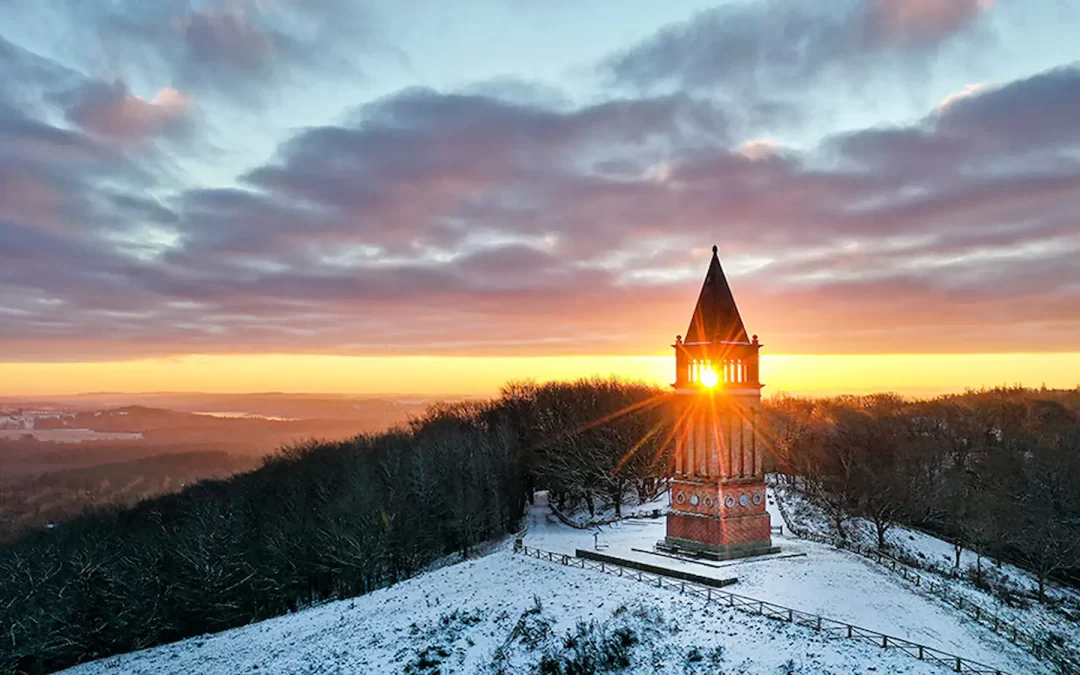
Still, with such an ambitious intention, it helped that we were gathering at not just any mountain. It was at Himmelbjerget, the birthplace of Danish democracy, with a sloping grassy field where people first gathered in the mid-1800s to talk and sing together and imagine an alternative to absolute monarchy. Ever since then, tourists come by the hundreds of thousands annually to celebrate the resulting Constitution and to enjoy the natural beauty of the land and lakes. In recent years, people have again started to assemble there to talk and sing together with renewed intention: this time to imagine a Constitution that includes the rights of Nature — a challenging task, it turns out.
Our gathering there was sparked by timely local circumstances. Several years ago, the municipality had hired an architecture firm to develop ambitious plans for growing tourism in the area (there was some talk of doubling the number of visitors). The plans sparked citizen protests that forced them to retreat. Then, last year the municipality purchased the Himmelbjerget hotel, which was in clear need of refurbishment. They announced an intention to remake it into a Center for Democracy, though no details were shared. Days before our gathering, another public meeting was held to share more information. Another architecture competition was being launched, again with a lack of community engagement, clear vision or — in the opinion of many — integrity. Particularly galling for some was the stated intention to construct a tall overlook at the water’s edge, in violation of the government’s own environmental regulations.
In an added layer of significance, Norse mythology portrays Himmelbjerget as the place where the god Heimdal blows his horn to signal the onset of “ragnarök,” a series of natural disasters in which people turn violently against each other, lands burn and the seas rise to cover the world. In the legend, the world is renewed after the apocalypse. But this offers little comfort to those who see growing parallels to ragnarõk in modern times.
All of this provided a potent context for exploring the intersection of tourism, democracy and the natural environment in a changing world.
Hosted at the neighboring Himmelbjerggården — Nordisk Inspirationscenter, participants came from tourism, culture, research, local communities and civil society. We were close to 30 people.
What I shared with the group was that tourism, democracy and our relationship with Nature are each in the throes of a fundamental shift in paradigm. What we are moving away from is the still-dominant mechanistic worldview that tells us that we are separate from each other, from our organizations and from Nature; that productivity and profitability are what matter most; that more is always better; and that efficiency is the best way to get to those outcomes.
As that worldview leads us to the brink of extinction, we’re seeing in all three domains the (re-)emergence of a worldview in which what matters most is life’s ability to thrive.
TOURISM
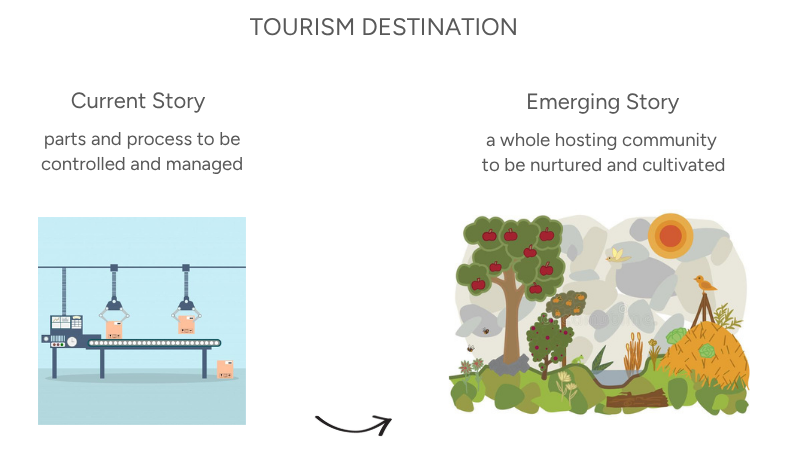
In tourism, that looks like a current story in which each place is seen primarily as a destination that can and should be managed and controlled. The metaphor of a conveyor belt comes to mind: the purpose is to get as many tourists through, as quickly as possible, shaking as much money loose from their pockets as possible in the process. The community and natural environment generally don’t feature in that story, unless they are attractions along the conveyor belt.
No one goes into tourism with that story in mind. And yet, we see its effects in a growing number of places, with overtourism, degradation of the natural environment, loss of cultural uniqueness and diminished quality of life for residents. As a result, we see more and more communities starting to reject tourism, recognizing that it is not fully working for them.
In response, there is the growing call to recognize places not only as destinations but as host communities, in which we host visitors, certainly, but we also host each other and we are hosted by the land and the life within it. In place of the conveyor belt, a multi-species ecology is a more accurate concept – not metaphor this time but literal description. As such, communities hold more complexity and potential than can be managed. Instead, the most appropriate approach is to nurture and cultivate the community’s own capacity to generate new possibilities and to regenerate what must be healed.
DEMOCRACY
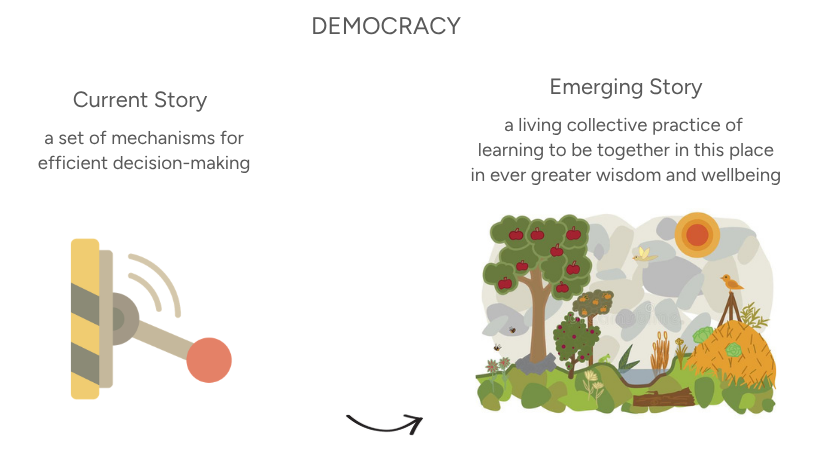
Likewise, the story of democracy has largely been reduced to the mechanism of voting, with the goal of efficient decision-making. We pull a metaphorical lever in order to get the decisions we want most. The Constitution is the instruction manual for the machine.
With such a simplified conception, we find democracies around the world crumbling before our eyes. When we don’t get the decisions we want, we too easily conclude that the mechanism isn’t working and that authoritarianism might be a better choice. Russia has voting and a Constitution. So does the United States. The mechanism is not enough.
What is (re-)emerging in response is a more complete understanding of democracy as an emergent collective practice of learning how to be together in our shared home. While voting is likely to remain as an important mechanism for decision making, it must be embedded within a larger story in which we recognize in our communities the characteristics of a living, multi-species ecology. With this recognition, the goal becomes cultivating ever greater wisdom and wellbeing for all. This is what the process of decision-making must serve, most of all. And this calls for development of a culture and relational infrastructure that enable more cohesion and collective capacity, more creativity, more healing.
Importantly, Denmark has quite such a culture and relational infrastructure. For example, the folk high school system stands out as an inspiring factor.
NATURE
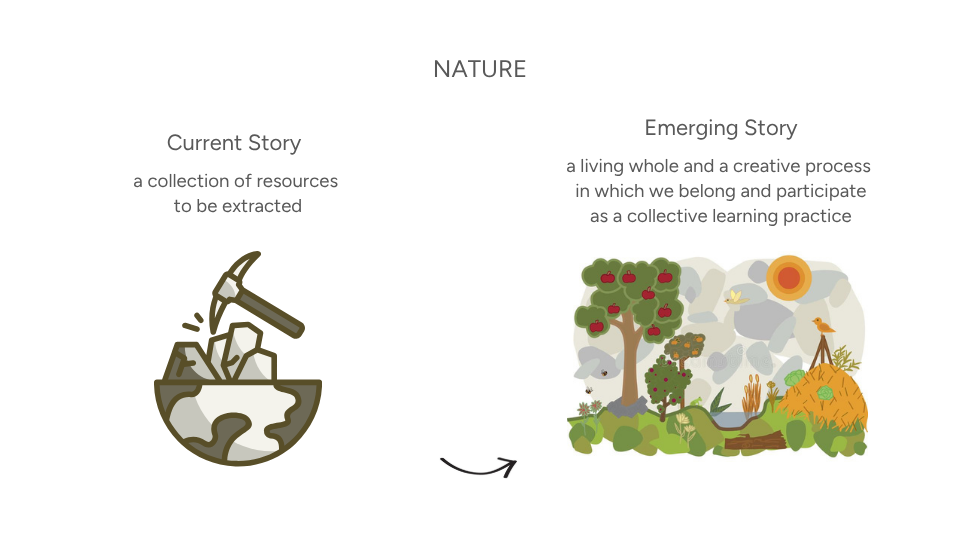
Finally, I pointed to the dominant story that Nature is a collection of resources to be extracted and services to be provided to humans. Of course, there is some truth to this, but there must also be more to the story if we are going to survive as a species.
In response to the existential crises we face, we see the (re-)emergence of a worldview in which Nature is not only a collection of parts but a living whole and a creative process. And we are not merely external, extractive takers; we are profoundly, inseparably embedded, participating as an ongoing collective learning practice.
Again, Danish culture seems to have retained such a story to a remarkable degree through the folk high schools, through songs, through mythology, and more.
THE REVOLUTION WILL BE HOSTED
What we see across each of these domains is that they are profoundly interdependent.
In democracy, it is not enough to add another lever labeled “Nature” to the voting mechanism. We seem to need a broader conversation about the nature of community, about our place in Nature, and about what guidance a Constitution must offer. We seem to need experiences of collective learning, and everyday practice grounds for participating within the larger living ecology.
This is part of what we were attempting to model in our gathering this week. And it was the reason my talk was limited to 30 minutes. Of far greater importance than my single perspective was drawing out the many perspectives in the room and sensing the emergent wisdom together. As our invitation said: “We find the answers by listening to each other and to the wise, old mountain.”
To that end, we drew on multiple participatory conversation methods. We walked through the forest to sit on the famed grassy slope. We brought perspectives of Nature into our discussions. We heard the history of the place and even sang together, as so often happens in significant gatherings in Denmark. We paused at times to stretch, breathe more deeply and integrate what we were hearing and sensing. In all of these ways, we expanded what it was possible to talk about and we accessed more of the intelligence of the ecology we formed.
But beyond this gathering, who could host us in this kind of reflection and discernment?
What I proposed is that those in the tourism sector are uniquely equipped to “host the hosts.” Tourism is connected to everything in a community: to business, government, infrastructure, culture, Nature, the law and more. Those in tourism are often natural conveners, including having spaces for gathering. They have influence but not authority, and so they are not threatening as hosts. And their work has roots in things everyone cares about in their shared home.
I offered a ridiculously simple example of what this can look like. Not long ago, the Destination Management Organization (DMO) in Stratford, Ontario, led a project to expand the downtown public washrooms from three toilets to seven. They did it in a way that engaged the community creatively and collaboratively. And the result was a washroom that reflects the uniqueness of Stratford. Visitors appreciate it, and that means that downtown businesses benefit. The project has even won awards. But the most important outcome is a community that is more cohesive and more capable of generating new possibilities. This is what director Zac Gribble means when he says that Destination Stratford’s role is to be “an incubator for community wellbeing.” Anything can be a practice ground for thrivable democracy.
I also shared the moving story of a DMO in Flanders, Belgium. Some years ago, they convened the community in a series of conversations to discern “sacred principles” for how they would commemorate the centenary of World War I. Those principles then guided the actions of individual businesses and also citizens, who came to see themselves as hosts, too. The story started with protests from community members, in obvious parallels with Himmelbjerget. In the case of Flanders, it turned out more beautifully than anyone could have imagined. This is the great promise of a living practice of democracy.
“But how will I convince others to do this regenerative approach?” asked one DMO representative. “I have to answer to 250 VAT numbers,” he said, referring to the DMO’s member businesses, “and they just want to know about the bottom line.” The mechanistic framing was not lost on me: people and living organizations reduced to numbers, with assumptions about the limits of their interests. But the practical concern is real.
“There’s no need to convince anyone,” I shared with him and the whole group. “Find something people care about and convene them around that. Host them in a way that grows compassion, creativity, cohesion and wisdom, without telling them that’s what you’re doing. Find a small number of others who also see the value in this kind of hosting, and work with them behind the scenes to sense what the others are ready for. Maybe sitting in a circle will be too much at first. Maybe they’re not ready to take on the most complex and challenging project right away. Build up collective capacity over time. The point is to expand the things we can talk about and the benefit we can serve.”
As we closed the conversation, there was a buzz of energy and emotion in the room. We don’t know what will happen next, or what will be the fate of Himmelbjerget. But as I reflect on the state of the world and the uniquely potent circumstances of that place, I can’t help but hope that a Center for Democracy will indeed emerge, not only documenting Denmark’s democratic past but hosting an exploration and experience of humanity’s democratic future. Not only growing the number of tourists but growing our capacity to enable life to thrive.
Photo credit: Karsten Bak Grosen for Danmarks Smukkeste