
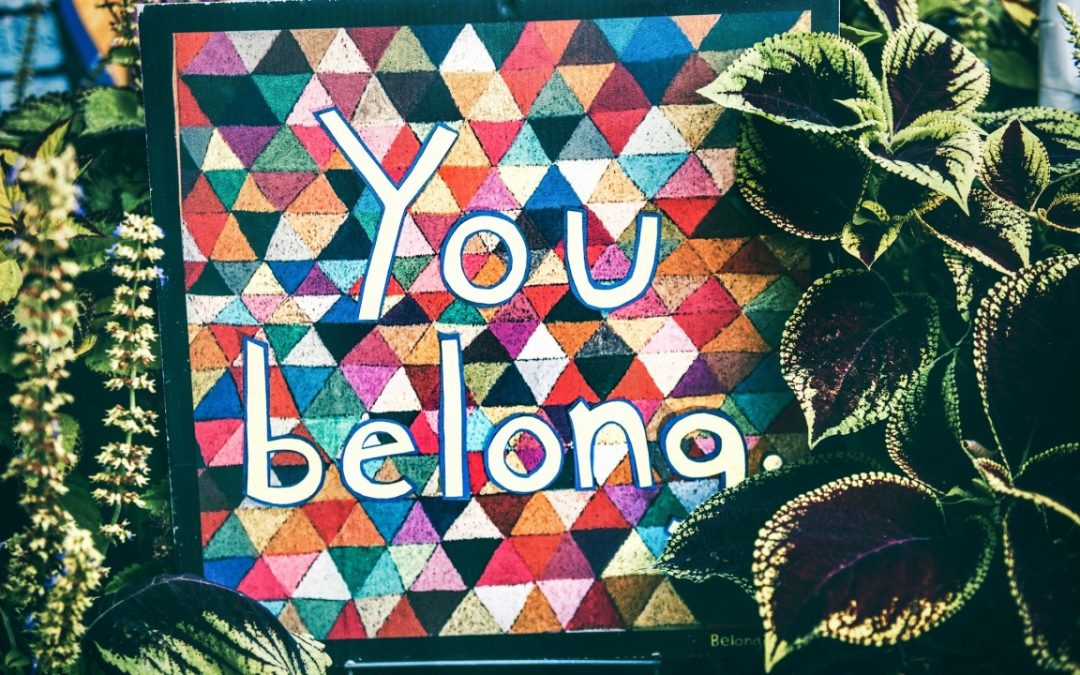
I’m seeing a growing focus on relational approaches to system change, and within that, on creating “belonging without othering.” This is so welcome and needed. But I’m not always sure it’s clear that belonging is an emergent phenomenon. We can’t create belonging; we can only create the conditions for its emergence. And relationship is only one of the necessary conditions.
In my own work, what I have seen is that belonging and regenerative system change emerge from an unfolding relational space in which people are welcomed to contribute in diverse ways to a life-aligned shared purpose.
Woven inconspicuously into that statement are the core patterns of all living systems, what I think of as Life’s Universal Design Principles. In every thriving living system, there are:
- Diverse Parts (diverse contribution),
- In dynamic patterns and structures of Relationship (relational space),
- Brought together in convergent Wholeness (shared purpose),
- Animated by the spark of Life (life-alignment; responsive participation in unfolding aliveness).
In human contexts, we can frame these conditions as Passion, Practice, Purpose and Potential.
- We each have agency to share what we are passionate to contribute.
- We engage in a rich practice ground of relationship, thoughtfully shaping our information-sharing and decision-making; working to grow trust; attending to power dynamics; weaving layers of context into our relational field.
- In shared purpose, we co-create a larger whole to which we all belong, embracing our mutual responsibility for a shared vision and narrative of possibility, generosity and healing.
- And we do this not through tight control but as an unfolding manifestation of life’s emergent potential that can only be expressed through us. We attune, discern, learn and respond as an individual and collective practice of stewarding life’s ability to thrive.
If any of these conditions are not well cultivated, the experience of belonging will be weak at best, little will be generated, and little system change will occur.
If all of them are well tended, it feels like magic. We surprise ourselves with our own genius. New things become possible. It feels like healing. Like home.
I have a framed, carved ceramic tile that says “This joy you feel is life.” I believe it’s a quote from Gertrude Stein. By the same logic, I would say: “this belonging you feel” is also life. What we feel belonging to or within is life’s flow. We are woven back into the fabric of life, even if only for a time.
Photo credit: my mom 🙂
In some ways, all of this adds complexity to an already challenging situation. It’s hard enough to make the case that relationship is important — even more to make the case that belonging is vital civic infrastructure, as my friend Duncan Ebata 🔥🥘 does with the Front Street Community Oven.
But as Eisenhower advised: “if there is a problem that cannot be solved, enlarge it.”
Maybe part of why it’s so hard to make the case for relationship and belonging is that they lack a large enough framing. On their own, they too often still sit within the prevailing mechanistic paradigm of prediction, control, efficiency and reductionism. And there, they don’t have real value or validity.
Just as much as we need to work with all of life’s design principles, we also need the underlying recognition that we’re working from an ecological paradigm.
When we explicitly see ourselves, our projects, our organizations and our communities as dynamic living systems, we more naturally embrace our role as stewards of these core conditions of our thriving.
This is the fullness of what Duncan and his colleagues and neighbors have taken on with the Community Oven. In committing to the full intention and practice of stewarding life’s ability to thrive, they’ve articulated the “recipe” below that guides their actions. See if you can detect life’s universal design principles woven throughout their words.
The result is that a simple brick oven in a tiny park is a vibrant space of belonging and generative system change. People connect across cultures and generations. Those who need help find it in community. New conversations become possible. Projects emerge. Joy is abundant. Healing happens. You can read more about the “magic” of the Oven here.
This is one particularly beautiful example of what is possible in any context. And this informed intention and practice is more important than ever. For so many of us, the yearning to belong is a constant ache. And it has societal and civilizational implications. Isolation is one of the primary preconditions for authoritarianism. And the multiple, global crises we face will require us to work together within new levels of complexity.
I am wildly encouraged to see the growing emphasis on relational approaches and belonging. And I will be even more encouraged when they are more often framed within a larger practice of stewarding life’s patterns of thriving.



ralph martin has to stop being so mean to me 😢